
 No. 3009 Flying Dutchman in 3001 class form
Photo source: Wikipedia
However there were problems due to the HUGE 7ft 8in driving wheels. Despite the fact that the 3001 class were fitted with the largest boiler ever fitted to a GWR 2-2-2 locomotive the boiler was constrained because it had to fit between the huge driving wheels. On most locomotives this problem wouldn’t have happened as the driving wheels are usually smaller and so their height does not affect the boiler and its workings. This meant when the boiler capacity was increased it could only been done by making the boiler longer and not wider. As a result what happened was the smokebox and cylinders were now in front of the leading axle. This meant trouble as the extra weight of the larger wheels put extra stress on the leading axle and made locomotives unstable especially at speed. Disaster happened on 16 September 1893 Great Western locomotive number 3021 Wigmore Castle was hauling an express train, when it derailed in Box Tunnel when the front axle broke. The cause of the accident was thought to be excessive weight being carried on the front axle, so it was decided to replace the leading pair of wheels in the 3001 class with a bogie. The is in turn created more problems because of the steam chest on the 3001 class which was located underneath the cylinders and contained two slide valves. The inverted placement of the valves allowed them to drop away from the face of the steam ports when steam was shut off, thus reducing wear. A conventional bogie design would of obstructed access to the steam port faces so William Dean instead used a suspension bogie which was unique at the time.
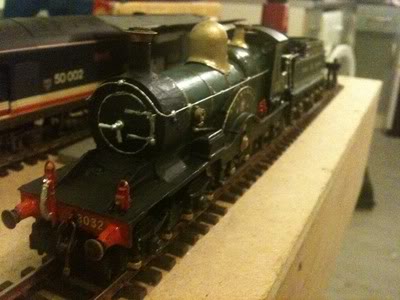 My Dean Single Model
The Dean Single I know and love first appeared when 3021 Wigmore Castle the box tunnel victim was rebuilt as a 4-2-2 in March 1894 with the other members of the class being rebuilt between June and December 1894. The second batch of the Dean Singles were built at Swindon works between March 1894 and March 1899. Due to the huge changes in the design from the 3001 class the new locomotives and rebuilds were reclassified as 3031 Achilles class, named after the first locomotive of the new batch of singles.
These new locomotives differed from the rebuilds in having their cylinder diameter reduced from 20 inches to 19 inches, and the springs for the trailing wheels located above the footplate and outside the cab, necessitating a reduced width for the latter. The evolution of the Dean Single didnt stop here as from 1898 their driving wheels were increased by half an inch to 7ft 9in when they were fitted with thicker tyres.
3015 Kennet was involved in the 1900 Slough rail accident
3021 Wigmore Castle crashed in Box tunnel in 1893.
3041 The Queen, originally named James Mason, was an example of this class allocated to Royal Train duties. A replica was built in the 1980s and currently lives at Windsor station.
3065 Duke of Connaught made a record-breaking run with the Ocean Mail on 9 May 1904, covering the distance from Plymouth to Paddington in 227 minutes.
3046 Lord of the Isles has enjoyed a certain amount of celebrity, having been chosen as the prototype for a Tri-ang model locomotive. Since then the engine has also been modelled by Brio and Matchbox.


 Loco Yard
Pingback: Hornby Lord of the Isles Review | Loco Yard